
Free Randomize Lines
Randomize line order without changing line content or duplicate frequency, and optionally reproduce the same ordering with a seed.
Browser-local text utility
Runs in your browserEnter your text
Choose the exact operation before creating an output.
Editable plain text · up to 200,000 characters · text is never included in a share URL
0 words0 characters0 lines0 paragraphs
Runs in your browser. The operation is deterministic except an unseeded line shuffle. No source text, result text, seed, search term or comparison content is sent to ScholarTool services.
Current result
Randomize Lines results
Every visible metric and finding below comes from the current inputs and result.
Complete an operation to begin
The dashboard will show only real output and observed changes.
0 words0 characters0 lines0 paragraphs
Editable output · these counts and the After card recalculate after manual edits
Detailed findings
Use this result
Result utilities
Exports use the current editable result or comparison.
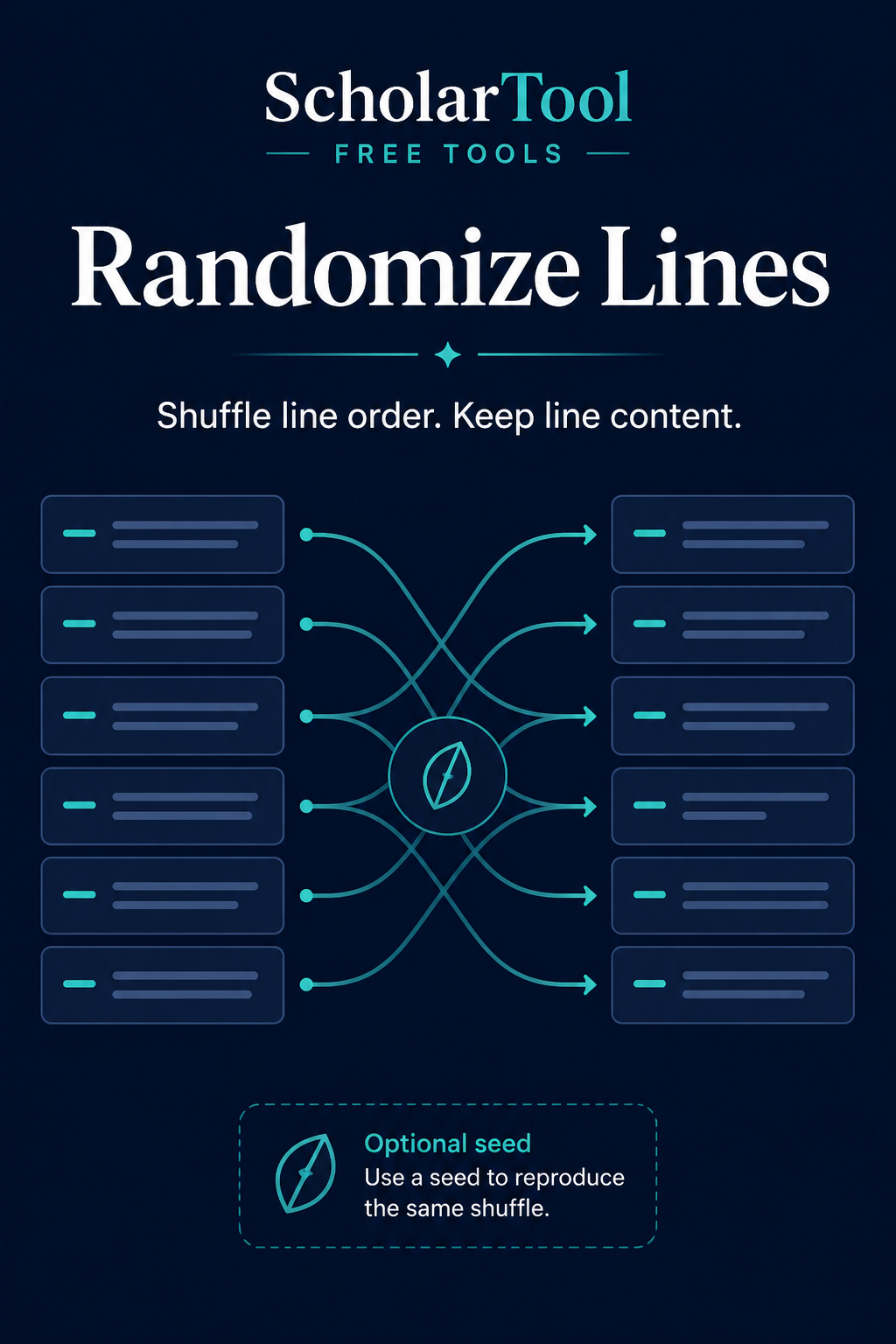
What is line randomization and what does this Randomize Lines do?
Line randomization permutes a list while keeping each line intact. This tool uses Fisher–Yates; unseeded runs draw unbiased indices from browser cryptographic randomness, while a supplied seed selects a deterministic repeatable sequence.
How to use Randomize Lines
Paste one item per line.
Leave Seed blank for a fresh browser-random shuffle or enter a seed for repeatability.
Shuffle and review line, changed-position and seed-status cards.
Shuffle again, restore the original or copy the editable result.
Key features
- Unbiased Fisher–Yates permutation
- crypto.getRandomValues for ordinary unseeded runs
- Optional deterministic seeded mode
- Duplicate and line content preservation
- Editable output with repeat and restore actions
Input guide
Every physical line participates in the shuffle, including blank lines and duplicate values. A seed can be any short text; the same exact input plus seed yields the same order in this implementation. Seeded mode is for reproducibility, not security.
How to understand your results
Total Lines counts every line. Changed Positions compares output positions with the original, Seed Status distinguishes browser-random and reproducible runs, and Shuffle Runs counts explicit actions in the current page session.
Worked example
Example input
red green blue yellow
How to read it
An unseeded run returns one of the valid permutations. With seed “lesson-4,” the same four source lines produce the same permutation whenever that exact input and seed are reused.
Common use cases
- Randomize quiz or discussion prompts
- Shuffle participant or task lists
- Create a reproducible randomized order for a lesson
- Test software with varied line sequences
Randomize Lines guidance and best practices
- Use a recorded seed when another person must reproduce the order.
- Keep duplicates when they represent separate entries; this tool never deduplicates.
- Do not use this convenience utility for lotteries, cryptographic protocols or regulated selection.
Limitations, assumptions and cautions
- A random permutation can occasionally match some or all original positions.
- Seed behavior is specific to this implementation and is not a cryptographic promise.
- Blank lines are shuffled as real entries.
Privacy and processing
Runs in your browser.
The list, seed and generated order remain in the browser. Sharing copies only the canonical tool URL.
Continue this workflow
Related tools
These live canonical tools support a practical next step without duplicating this task.
Helpful answers
Randomize Lines FAQs
Clear guidance for choosing and using the catalogue responsibly.
What does Randomize Lines do?
It changes only the order of complete lines using a Fisher–Yates permutation.
Does the tool change the content of each line?
No. Line strings and duplicates are preserved exactly; only their positions change.
How is the line order randomized?
Unseeded mode selects unbiased Fisher–Yates indices with crypto.getRandomValues when the browser provides it.
Why not use ordinary alphabetical sorting?
Sorting produces a predictable order from values; randomization intentionally creates a permutation unrelated to alphabetical rank.
Can I shuffle again without re-pasting the list?
Yes. Shuffle Again applies a new run to the original input.
Can blank lines be preserved?
Blank lines are preserved as entries and participate in the shuffle.
What does a seed do?
A seed drives a deterministic generator so the same input and seed reproduce the same order.
Does the list remain in my browser?
Yes. Neither the list nor seed is sent to a server.